Jared Devore
Bag of BonesJared Devore is a racist community power whose violence against Sara Tidwell and her son, Kito, binds his descendants and fellow townspeople to a concealed crime. Though long dead by the events narrated in the present, he appears in the time-slip at the Fryeburg Fair and again as a ghostly leader on The Street, turning his old demand for custody of a child into a supernatural threat to Mike Noonan and Kyra.
Identity and Afterlife
Jared is identified in the past-facing vision as a logger and as the ancestor whose family line leads to Max Devore. At the Fryeburg Fair, Mike recognizes an old man in a faded blue Union Army cap as resembling Max, but not actually being him: the face is leaner and subtly different. In the later confrontation on The Street, the distinction becomes explicit. The figure wears Jared’s clothes, while Mike understands him as Max’s great-grandson, dressed as Jared had been around the time Lance was born. Jared’s presence thus comes through both a ghostly appearance and a borrowed family likeness.
The blue cap and cutters’ clothes make the apparition recognizable across the two encounters. At the fair, the apparition appears with a group of men; later, other spirits form a line behind him on the path. The dead are not presented as a single undifferentiated crowd: some seem faded and insubstantial, while Jared and several others have a more immediate presence. His continued authority among them makes the past feel less like a completed history than a force still organized around his commands.
Authority and Recruitment
Jared’s influence over the young men rests on more than family position. During the summer of 1901, he repeatedly told them that they had a duty as men to keep the community pure and to act on what others would not. His rhetoric was explicitly racist, directing slurs at Sara and presenting racial exclusion as civic responsibility. The language casts violence as a collective obligation rather than an individual choice, while allowing Jared to set the purpose and the terms.
The group’s loyalty survives into the supernatural scenes. At the fair, Jared demands that Mike hand Kyra over, invoking a custody claim even after death. One of the younger men eagerly offers to take her; Mike recognizes him as Bill Dean’s father. This response links the ghostly following to living Castle County families and shows how deference to Jared reaches into later generations. Jared refuses the offer of assistance, insisting that Mike will surrender Kyra voluntarily or the men will take her together.
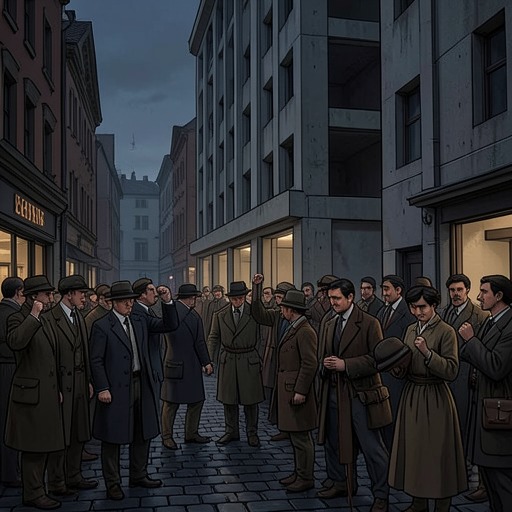
The later assembly on The Street includes men Mike can identify by their family ties: Fred Dean, Harry Auster, and the father of Royce Merrill. These identifications give Jared’s following a local genealogy. His command over the group is also shadowed by its consequences: Draper Finney, one of the young men drawn into Jared’s circle, would later die in a quarry accident described as partly deliberate, haunted by memories of what happened that summer.
Attack on Sara and Kito
Jared’s campaign against Sara becomes physical when he encounters her during a quiet Sunday afternoon on The Street. After he falls, Sara laughs; the narrative identifies that laugh as the decisive mistake that turns the encounter into an assault. Jared responds by ordering the others to stop her from calling for help. The young men restrain her, and Jared continues to direct them, making his authority part of the violence rather than a distant prelude to it.
When Kito is brought back after running for help, Jared orders that the boy be put in the water and silenced. The command exposes the scope of the danger: the attack is not confined to Sara, but extends to her child as a witness. Some of the young men hesitate when faced with harming Kito, and they loosen their hold on him, allowing him to pull free. Their hesitation does not undo the violence against Sara, but it marks a limit Jared’s influence does not entirely erase.
The account places Jared’s assault within the broader mechanism of a cover-up: he fears that Kito’s testimony could expose the men to punishment, and he uses that fear to press the group into action. His repeated talk of communal purity is therefore revealed as a justification for personal and collective violence, not a neutral concern for the township. Sara’s later fate and the concealment of the crime make his actions part of the history that the living must uncover.
Narrative Role and Legacy
Jared’s return is structured through recognition and resemblance. At the fair, Mike sees a figure who evokes Max Devore but is not Max; on The Street, he understands that Max has appeared in Jared’s clothing. The overlap makes the family’s history visible in the present without collapsing the generations into one person. Max’s later struggle for Kyra’s custody echoes Jared’s demand that Mike surrender her, converting an inherited pattern of domination into an immediate supernatural confrontation.
Jared also gives shape to the collective memory of TR-90. His followers include ancestors of men known to Mike in the present, while Jo’s whispered appeal to understand that they were very young complicates the scene without excusing them. The episode’s concern is not only with Jared as an individual aggressor, but with the way his words recruited a group and left consequences in families, deaths, and local silence. The apparition makes that inheritance impossible to treat as safely past.